Why does the passage of time seem to accelerate as we grow older?
This is a good question. Rose often talked about the concept of 'duration', and how we actually determined the length of a second, minute, or an hour. He said that space and time were incontrovertibly intertwined, and without space there was no time, and without time there was no space, as is the subject of scientific relativity experiments. To a man in a delirium, a second can seem like an hour, whereas to a man in love, an hour with his beloved can seem like a second. It may well be that time is not passing, and that it is our consciousness or awareness that is moving though an already played out strand or drama, of which we take ourselves to be the main character. We are but a Witness, in the Final Analysis, though this is theory until proven by experience for each individual.
skip to main |
skip to sidebar


YOU ARE A ROBOT

For more, in-depth information on the subject of temptation and Richard Rose's psychology, go to www.richardrosepsychology.com


Where I get my best work done.
Law of the Pyramid: "The only hope of man lies in the existence of a source of knowledge or direction that is human. And while some may say that all lies within ourselves, we find that even the cloistered monks find a need for cooperation with other humans to secure their meditation. There are, besides teachers of relative wisdom, teachers of direction which are most rare." - Richard Rose

Peace Of Mind, Success Without Regret
Music Inspired By Expanding Consciousness
Soul Food!
" Maintain Truth in all endeavors. Keep things simple, and direct. Stray not from your commitment." John Rose
Poster From the Early Days
YOU ARE A ROBOT
We Are Back!
The Pyramid Zen Blog is back on track after a long time of being dormant. Let's get some energy going and share ideas, experiences, and anything that may help one another on the Quest. Check back often as I am in the process of posting new material. Looking forward to your observations and ideas.
The Sex Connection
For more, in-depth information on the subject of temptation and Richard Rose's psychology, go to www.richardrosepsychology.com
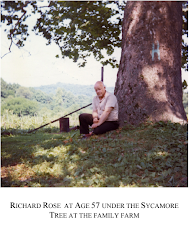
Richard Rose
In The Front Yard
Blog Archive
-
►
2008
(6)
- ► 04/06 - 04/13 (1)
- ► 03/16 - 03/23 (1)
- ► 03/02 - 03/09 (1)
- ► 02/17 - 02/24 (3)
-
▼
2006
(7)
- ► 12/03 - 12/10 (1)
- ► 11/05 - 11/12 (1)
Your Moderator, John Rose
Where I get my best work done.
About Me
- PyramidZen Admin
- The Pyramid Zen Society is a small group of students who subscribe to the teachings of Richard Rose. We opened this blog site to encourage self-inquiry, using the principles and "yardsticks" that Mr. Rose specifically laid out for such work. All questions will be answered within the context of that teaching since we have found it to be such a valuable resource on our own paths. We discourage argument for the sake of promoting an agenda or prosyletizing. However, constructive critical exchanges and even planned confrontation sessions on a particular topic can be helpful tools in the process of overcoming obstacles on the spiritual path. The monitors of this site reserve the right to disregard any content deemed inappropriate to its primary philosophic purpose.
Recomended Reading
- Carillon: Poems, Essays, and Philosophy of Richard Rose-(147 pp.) PB - ISBN: 978-1-878683-03-8
- Energy Transmutation, Between-ness and Transmission-by Richard Rose-(68 pp.) PB - ISBN: 978-1-878683-02-1
- Meditation-by Richard Rose
- Psychology of the Observer-by Richard Rose-(133 pp.) PB - ISBN: 978-1-878683-06-9
- The Albigen Papers-by Richard Rose-(240 pp.) ISBN: 978-1-878683-00-7
- The Direct Mind Experience-by Richard Rose-(316 pp.) ISBN: 978-1-878683-01-4
- The Sex Connection, A Study of Desire, Seduction and Compulsion-by Alan Fitzpatrick-(371 pp.) ISBN 9780977614714
Soul Food Archive
- "Each man blooms from a different catalyst. The only thing hat the enlightened men have in common is that which they find."
- "There is only one time to start and that is now. And we can expect to battle the urge to procrastinate from now on."
- "Let me remind you That the perceived Cannot perceive." Huang Po
- "Come to see all things directly."-source unknown-
- "If you do not fast from the world, you will not find the (Father's) kingdom." The Gospel of Thomas-Translated by Stephen Patterson and Marvin Meyer
- "Even the spiritual path can become a distraction. We settle into a comfort zone, reading, talking, listening. We run through it like a field, never stopping to observe what goes on there, or when we do we personalize it, make it out to be what we want it to be rather than making an effort to see it as it is or isn't as the case may be. " John Rose
- "The path to Truth begins with the self. We cannot properly isolate, identify, or analyze the self, because it is the subject about which we know the least." Richard Rose
- "Religious democracy gives the false sense that we are all going to make it, and that may not be the case. If you do your research and read accounts of other experiences then you may find out many things for yourself rather than just riding the tide into heaven." Richard Rose
No comments:
Post a Comment